useNature.com .... Benefits of Tea - The Tea Guide

The Tea Guide - benefits of Tea
Natural Health Lifestyle Online Magazine
Holistic Health & Lifestyle Information
Article: The Tea Guide
The Tea Guide and the benefits of Tea
Article by ... the editor of Use Nature, Dieter Luske N.D.-D.C.H.-D.M.H.-D.H
Author of It happened in the seventies
The Tea Guide
Brewing Tea
Tea comes in many forms, and I don't mean "different tea bags". I am talking more about real leaf tea.
I am all for pure, preferable organic tea, nothing artificial added.
Preparation is usually very easy, unless you are a true connoisseur and have tea brewing rituals. Otherwise, brewing tea is easy, but it isn't like brewing coffee. It takes a certain amount of attention to produce your best cup of tea. Yet, it is truly one of life's simple pleasures.
Good Tasting, Cold Water is Important
First fill a kettle with just enough cold water for the tea you are going to drink soon. I use filtered good tasting cold water; it doesn't matter where it comes from as long as it tastes good. Don't use hot water because it will taste flat from the lack of oxygen while standing in the water heater; also the oxygen in the water is necessary to get good flavour from your tea.
When the kettle starts boiling, pour a little hot water into the tea pot or cup to pre-warm it. If using a cup, be sure to cover it with a saucer while waiting for the water to finish boiling.
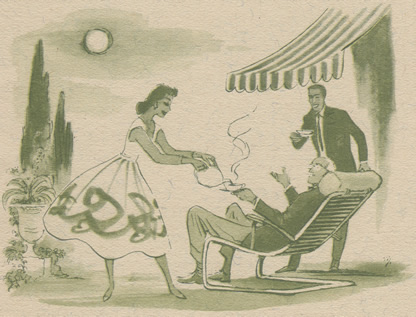
Illustration from an old tea guide - 1950th
Water Temperature is Important
Black tea needs more time to brew than green tea and the water must be boiling for black tea.
Do not use boiling water for green or herbal tea or your tea will taste bitter or herbal essential oils will have been evaporated.
The rule of thumb is to let the water come of the boil, wait for 60 seconds for green tea.
Measure 1/2 to 1 tsp. of tea per cup into your pre-warmed teapot or cup and let the tea steep for the recommended time:
Black tea, not longer than 4 min or it gets bitter.
Green tea, for best quality only 3min. - however for very good quality green teas, the tea leaves can stay in the pot, and re-used again.
Herbal teas with essential oils, with a lid on up to 10min.
How long to infuse Tea bags, not that I recommend them.
The time it takes to infuse different teas depends on the size and type of tea. Tea bags filled with small leaf bits, or dust may only require 30 seconds to a minute to infuse. If possible, check the label on the tea box for times.
You will probably like some teas stronger than others, with green and herbal teas, you may try different steeping times to find what you like best. Try tasting the tea while its steeping until you find the taste you like, then write down the steeping time for that particular tea.
Black tea should always brewed just 4 min. or if you like it weak, even less ... like 3 min.
When the Tea is Ready
You don't want to "stew" your tea so be ready to remove the teapot's infusing basket or pour the tea leafs through a strainer into your teapot. I recommend not using a tea ball strainer unless you half fill it so that the leafs can fully open. The tea leafs must have circulating hot water all around them to open fully.
How Many Infusions?
This really depends on your taste and the quality of the tea. Old tea that has lost its fragrant oils or has been heavily processed will likely only do with one infusion. Better quality teas will infuse better. Generally, quality green tea can be infused a number of times and good Oolong tea can be infused as many as seven times with the same leafs.
The Chinese say you derive different pleasures from each successive infusion.
I never infuse twice, I prefer the pure fresh first brewed tea. You may mix different tea leafs to achieve your favourite tea, or aim for a more therapeutic action.
I often add, Lemongrass, Sage, Lemon Balm or any of the mInts.
Tea has many health benefits, here are just a few:
Scientific Evidence for the following applications:
-
Anti Ageing and Anti Oxidant
-
Allergies, esp. Green tea, the antioxidants in green tea, may partly block the processes involved that produces allergic responses, helpful against a wide range of sneeze-starting allergens, including pollen, pet dander, and dust.
-
May facilitate higher bone mineral density.
-
There have been reports of tee being an Anti Cancer agent, once again probably mainly an anti-oxidant action preventing health cells turning malignant. Green tea may be more powerful and has higher concentration of an anti oxidant called EGCG.
-
Possible benefit for bladder problems.
-
Tea helps to lower Cholesterol and also helps with Heart Diseases by preventing blood from clotting.
-
Tea for weight loss has had a lot of attention over the years. Green tea or Jasmine tea is a slight diuretic which will help, further more, there seems to be enough evidence to suggest that green tea stimulates fat burning.
What is better, green, black or white tea?
One would need to suggest a good balance of all kinds. Each kind of tea has some specific benefits. Generally speaking, to take advantage of the benefits of tea, you need to consume 4 to 6 cups daily, which allows for some variation.
Why white tea? A possible higher anti-cancer quality.
What is "white tea" ? It is made from the fine silvery-white hairs on the unopened buds of the tea plant, which gives the plant a whitish appearance.
The tea is not white, but pale yellow, light to the taste. (White tea is "Not tea with Milk :-)
And ... remember ... use lose leaf tea, it has by far higher Anti Oxidant qualities and also tea leaf qualities. It's the better product all around.
Cleaning Up
Washing a teapot is simple. Just rinse, dry, and put away. The residue left on the inside of the teapot is considered a blessing and some people keep a separate teapot for each type of tea!
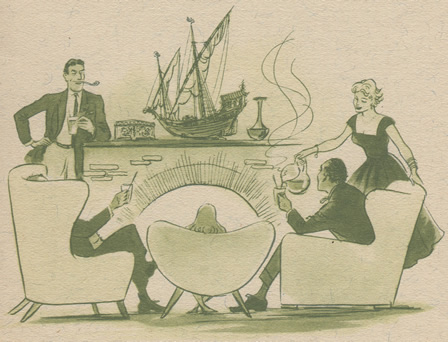
The Illustrations are from an old tea guide from the 1950th, and here is a interesting sounding recipe for a tea punch and one more illustration .. :-)
Tea Punch:
4 teaspoon of black Assam Tea into a pre-warmed teapot with 1 1/2 litre of boiling water. Steep for 4 minutes and strain.
Add the juice of 1/2 a lemon and the juice of 5 blood oranges. Add sugar to taste, plus 1/2 a bottle of Jamaica Rum.
Serve hot. (now you are talking :-)
Types of Tea:
Green or black tea need to be differentiated, not only for being just dried or fermented, but also where they grow and what variety.
Here are some well known Tea Types:
Darjeeling - Mild and soft aroma, gold-yellow colour.
Assam - strong Aroma - dark gold or gold-black colour.
Ceylon - touch bitter but full taste, gold-yellow colour.
.... and many more...
We haven't discussed herbal teas, as each specific herb has it's own medicinal and taste distinction.
Article supplied by the editor of use Nature - Dieter Luske
* Disclaimer - Any general advice given in any article should not be relied upon and should not be taken as a substitute for visiting a qualified medical Doctor.


 Dieter Lüske - Editor
N.D.-D.C.H.-D.M.H.-D.H
Editor's Articles

Facebook Groups
please join:
Buy Now

It happened in the seventies
A Memoir of Love, Colliding Worlds and a House on a Hill
Intriguing story of personal risk-taking, self-discovery and profound change.
Dieter Luske
author . writer . editor
Alchemix
Recording Studios
Sound Production:Recording - Mixing &
Mastering Services
Voice Overs
© 1998 - 2025 useNature.com: Australia - Natural Health and Lifestyle - Holistic Health Information Services
Site Map - Terms / Privacy - Global Health | Free Alpha Music | Photography | Natural Links |